
Summary:
- A single tooth implant replaces one missing tooth with a titanium post, abutment, and crown, without touching the teeth next to it.
- Treatment typically takes three to six months from consultation to finished crown, longer if a bone graft is needed.
- At Newlife Dental, a single tooth implant starts from S$4,500 before GST, and MediSave may cover part of the cost for eligible cases.
- Candidacy depends on bone volume, gum health, and controlled underlying conditions, with smoking linked to higher failure risk.
You may think a missing back tooth only affects chewing, but if you’re avoiding smiling in photos or hiding your teeth when you laugh, it’s likely affecting your confidence too.
A dental implant is a popular route for single tooth replacement in Singapore, largely because it doesn’t touch the teeth next to the gap.
Here’s what it involves, from cost to recovery.
A Misconception We Often Address at Consultation
[Patients often feel in the initial phases that they may not need to replace teeth that they have lost due to decay, infection, or trauma. However, many change their minds after a period of trying to chew and lead a good quality of life with missing teeth. Front missing teeth affect speech and appearance, while back missing teeth affect the ability to break food down properly before swallowing.]
The Quick Answer: What Is a Single Tooth Implant?
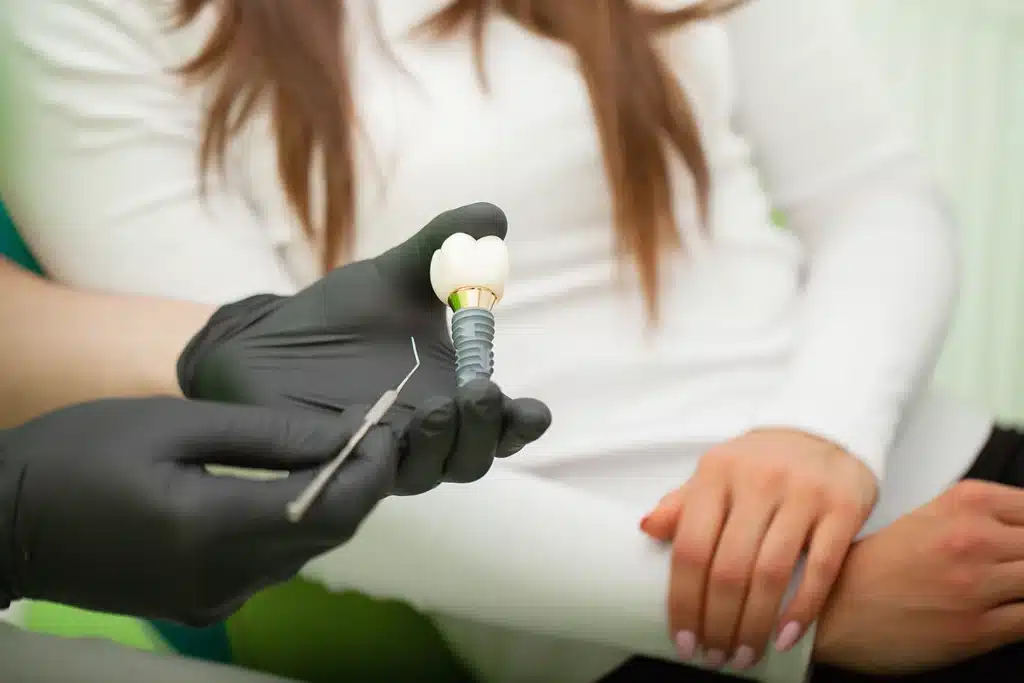
A single tooth dental implant replaces one missing tooth, and it’s built from three parts working together.
The Three Parts of an Implant
- Implant post: Titanium, replaces the tooth root and sits securely in your jawbone
- Abutment: A small connector piece linking the post to your new tooth
- Crown: Ceramic or porcelain, shaped and shaded to match the rest of your smile
Single Tooth Implant vs Dental Bridge vs Root Canal: Making Sense of the Options
Here’s how other tooth replacement options compare.
Implant vs Dental Bridge
A dental bridge works by grinding down the two healthy teeth next to the gap, then anchoring a false tooth between them. An implant takes a different approach and leaves your adjacent teeth untouched.
Implant vs Root Canal
Root canal treatment solves a different problem altogether. It’s aimed at saving a tooth that’s still in your mouth but infected or badly damaged, whereas an implant comes in once a tooth is already gone or can’t realistically be saved.
Comparing Your Options at a Glance
| Dental implant | Dental bridge | Root canal | |
|---|---|---|---|
| What it does | Replaces a missing tooth | Replaces a missing tooth | Saves a tooth still in the mouth |
| Effect on adjacent teeth | None | Adjacent teeth are filed down | None |
| Effect on bone at the site | May help preserve it | Does not protect it | Not applicable, tooth is retained |
| When it applies | Tooth already lost or beyond saving | Tooth already lost or beyond saving | Tooth is damaged but salvageable |
How Long Do Implants Last?
With good oral hygiene and regular dental check-ups, dental implants can last for many years. While the replacement tooth (crown) may need to be renewed at some point, the implant itself often remains strong and stable.
Not sure which option is right for you? The team at Newlife Dental Practice can walk you through it. Book a consultation to find out.
The Single Tooth Implant Procedure at Newlife Dental Singapore
Here’s what the journey from consultation to finished crown generally looks like for a single tooth dental implant.
Consultation and Imaging
Treatment starts with a consultation and a Cone Beam Computed Tomography (CBCT) scan, a three-dimensional X-ray that gives your dentist a clear picture of how much bone you have to work with.
From there, you and your dentist will talk through whether a standard or ultra-short implant suits you, before any implant procedure is commenced..
The ultra-short option (5.2mm) can suit patients with less bone height and may mean skipping a bone graft altogether, while the standard lengths (8 to 14mm) suit those with plenty of bone to anchor into.
What Does Our Stability First Philosophy Mean in Practice?
Stability First is the principle behind how we plan every implant at Newlife Dental Practice: prioritising a stable, well-integrated result over the fastest route to a fixed tooth.
In practice, this can mean choosing an implant system positioned to work with your existing bone rather than against it, planning around your own CBCT scan rather than a one-size-fits-all protocol, and recommending a bone graft, sinus lift, or ultra-short implant, whichever gives the most stable outcome for your particular bone.
Healing and Osseointegration
Once the implant is in place, it needs time to bond with the bone around it, a process called osseointegration. This typically takes three to six months, though it varies from person to person.
Fitting Your Crown
Once that healing is done, the abutment goes in, and your crown is fitted and adjusted to be harmonious with your existing bite.
Every mouth is a little different, so your dentist will walk you through what your own treatment plan looks like.
How Much Does a Single Tooth Implant Cost in Singapore?
The cost of a tooth implant in Singapore is often the first question on people’s minds, so here’s how it breaks down.
What's Included in the Price?
At Newlife Dental Practice, a single tooth implant starts from S$4,500 before GST, covering the full procedure from surgery through to your finished crown.
| Cost component | Claimable under MediSave? |
|---|---|
| Consultation and imaging | No |
| Implant fixture | Possibly, as part of eligible surgical cost |
| Abutment | No |
| Crown | No |
| Bone graft (if needed) | Confirm at consultation |
What Affects the Cost?
Ceramic and zirconia crowns cost differently, which is part of why quotes vary between clinics. Other things that shift the price include the implant brand used, whether imaging is bundled in, and whether you need bone augmentation.
MediSave and Payment Support
MediSave can help cover part of the cost if you’re eligible. Your dentist will talk you through what applies to you at your consultation.
At Newlife Dental Practice, we look at your bone health, budget, and goals before recommending anything. Get in touch to start the conversation.
Is a Single Tooth Implant Painful?
If you’re considering a dental implant, it’s natural to be concerned about pain or discomfort. Here’s what you can expect.
During the Procedure
The procedure is carried out under local anaesthetic, and most patients report feeling pressure rather than sharp pain during surgery.
After the Procedure
Some soreness in the days afterwards is expected and is usually managed with prescribed pain relief.
How Long Does a Single Tooth Implant Take?
Timelines vary, but here’s a general sense of what to expect.
Typical Timeline
| Scenario | Typical timeframe |
|---|---|
| Standard treatment (consultation to crown) | 3 to 6 months |
| With a bone graft | Add 3 to 6 months for healing |
| Slower bone bonding | Varies by individual |
What Can Extend the Timeline?
Several factors can make the treatment process take longer. If the damaged tooth needs to be removed, your dentist may recommend allowing the area to heal before placing the implant.
Those with bone loss may require a bone graft, which needs time to integrate before the implant can be placed. In some cases, the implant itself also needs several months to fuse with the jawbone before the final crown can be fitted.
Smoking, certain medical conditions, and slower healing can also extend the overall timeline.
Are You a Candidate for a Single Tooth Implant?
Most people can be considered for a single tooth dental implant, but a few factors will shape whether it’s the right fit for you.
General Suitability
- Confirm you have enough bone to anchor the implant, or discuss bone augmentation or an ultra-short implant instead
- Treat any active gum disease before proceeding
- Ensure relevant underlying health conditions are well controlled
Smoking and Implant Risk
If you smoke, it’s worth knowing this is associated with a higher risk of implant failure. It’s worth being upfront about it with your dentist at your consultation, as it may shape the treatment plan they recommend.
Ready to Book Your Consultation?
The right choice for single tooth replacement in Singapore comes down to your own circumstances: how many teeth need replacing, your bone health, and your budget. Acting sooner rather than later can also help protect the bone in that area.
At Newlife Dental Practice in Singapore, treatment is built around your situation rather than a one-size-fits-all fix. We’ll look at your bone health, your bite, and what matters to you, whether that’s comfort, appearance, or keeping your other teeth untouched.
Book a consultation with one of our implant specialists today.
Frequently Asked Questions
How much does a single tooth implant cost in Singapore?
Prices at Newlife Dental Practice start from S$4,500 before GST for the full procedure, though the final cost depends on your specific clinical needs.
Can MediSave be used for a single tooth implant in Singapore?
It can, for eligible cases. Your dentist will go through what applies to you and confirm the details at your consultation.
How long does a single tooth implant last?
Long-term studies place implant survival at around 96% at ten years. The post often continues functioning well beyond that, though the crown on top may need replacement sooner.
What happens to the bone if I don't replace the missing tooth?
Bone at the site can begin to resorb (gradually break down) within weeks of tooth loss. This is one reason some patients choose to address the gap sooner rather than later.
Is a single tooth implant better than a dental bridge?
Not universally, no. It really comes down to your own situation: the health of your adjacent teeth, your bone levels, and what you’re hoping for long term.
Can I get a same-day tooth implant in Singapore?
Same-day, immediate-loading treatment is an option for some patients, but not all cases qualify. Your dentist can assess this during your consultation.
How Do I Care for a Single Tooth Implant Long Term?
An implant is cared for much like a natural tooth: regular brushing and flossing, along with routine dental check-ups, so your dentist can monitor the surrounding gum and bone. Good oral hygiene is one of the main factors linked to long-term implant success.
What Are the Signs of a Failing Single Tooth Implant?
Persistent pain, a loose implant, ongoing swelling, or discharge around the site can all be warning signs worth having assessed. Because these symptoms can have several possible causes, it’s important to have the implant checked by your dentist rather than relying on a symptom checklist alone.
Still Have Questions?
