
Summary:
- Short dental implants are designed for patients in Singapore with limited jawbone depth.
- They may reduce the need for bone grafting or sinus surgery, shortening treatment time and recovery.
- Clinical evidence supports their long-term success in appropriate cases.
Bone loss in the jaw is a common reason patients are told they cannot have dental implants. In the upper back jaw specifically, a natural process called sinus pneumatisation (where the sinus cavity expands downward after tooth loss, reducing the bone available for implant placement) makes it an anatomical barrier to treatment.
Short dental implants, available in Singapore, offer an alternative solution. For the right patient, they may make implants possible with less surgery, a shorter treatment timeline, and a faster recovery.
Ahead, we’ll explore how short implants work, who they suit, and what a proper assessment involves.
What Are Short Dental Implants?
Short dental implants are implants designed to work in shallower bone than conventional implants require, making them a potential option for patients who have been told their bone depth rules out standard treatment.
A conventional implant needs a reasonable depth of jawbone to anchor into securely. Short implants are engineered to achieve that same stability in less vertical bone.
Ultrashort dental implants are an even more specialised category, intended for highly specific situations.
At Newlife Dental Practice, short implants are considered part of a carefully planned treatment strategy. Whether they’re appropriate depends on a number of individual factors:
- Your bone anatomy and quality
- The forces your bite generates
- Your medical history
- What the final restoration needs to achieve
- An overall assessment of risk
Crucially, length alone does not determine whether a dental implant will succeed. These factors are also important:
- Stability
- Surgical technique
- Prosthetic planning (how the replacement tooth is designed and fitted)
- Load distribution
- Biological integration
Why Does Bone Height Reduce?
Bone does not stay fixed once a tooth is lost. Without a root in place, the jaw no longer receives the stimulation it needs from biting and chewing, and the bone in that area gradually breaks down and reduces in volume, which is a process called resorption. Several factors can accelerate or compound this:
- Tooth loss over time
- Gum disease
- Long-term denture use
- Natural bone remodelling
In the upper back jaw, sinus expansion after tooth loss leaves even less vertical bone for an implant. This is the situation that has historically led to recommendations for sinus lift surgery, which is a procedure that elevates the sinus membrane and adds bone graft material underneath to create more space. For many patients, that remains the right course of action. For others, short dental implants may reduce or remove the need for it.
Where short implants are used with a less invasive sinus lift, the surgeon reaches the sinus floor through the same hole drilled for the implant, rather than cutting a separate opening through the side of the jaw. The sinus membrane is lifted intact, graft material holds the space open, and the implant anchors into the surrounding native bone. This is the basis of the Sinus Stability Protocol, a clinical framework developed by Dr Aaron Hoo, Clinic Director at Newlife Dental Practice, which focuses on achieving mechanical stability at the time of placement rather than building bone volume first.
How Short Implants Could Change Your Treatment Options
For patients with limited bone height, short dental implants may mean the difference between a straightforward treatment path and a lengthy multi-stage surgical one, or between pursuing implants at all and giving up on them.
Historically, limited bone height meant grafting first, waiting months for it to heal, then placing the implant. In carefully selected cases, short implants can sidestep some or all of that process. They may lower the extent of grafting required, shorten the overall treatment timeline, and reduce what clinicians call patient morbidity (the discomfort, swelling, and recovery that comes with more invasive surgery). This can make treatment considerably more accessible, particularly for patients who are older, have other health conditions, or feel anxious about extensive procedures.
That said, short implants are not a simpler version of conventional dental implants. They require at least as much planning and technique, and in some respects more, because the margin for error in choosing the right patient is narrower.
If you’ve been told that extensive grafting or sinus surgery is the only path forward, it’s worth getting a second opinion before committing to anything. Speak to the team at Newlife Dental Practice and clarify whether a different implant strategy is possible for your anatomy.
Short Implants Are Not for Everyone: Here's Why That Matters
- Bone density and quality
- Bite forces and jaw mechanics
- Teeth grinding (bruxism, also assessed as part of Newlife’s holistic health evaluation)
- Available prosthetic space (the room available for the replacement tooth)
- Oral hygiene
- Relevant medical conditions
Some patients, after a full assessment, may still be better served by conventional grafting approaches. With short dental implants in Singapore, the goal is not to avoid surgery at all costs, but to find the approach that gives a long-term outcome for your specific anatomy and health.
The Science of Stability: How Modern Planning Makes Implants More Predictable
Once a suitable patient has been identified, the focus shifts to planning. An important concept at this stage is primary stability, or the degree to which an implant is mechanically secure at the moment it is placed.
The prevailing thinking in modern implant dentistry is that a stable, well-anchored implant in healthy native bone is what allows the body’s healing process to begin reliably. Stability first; biology follows. This principle sits at the centre of Predictive Dentistry, the broader clinical philosophy that guides how Dr Hoo and his team approach implant planning at Newlife Dental Practice.
Achieving that stability requires detailed imaging. At Newlife Dental Practice, the assessment process includes:
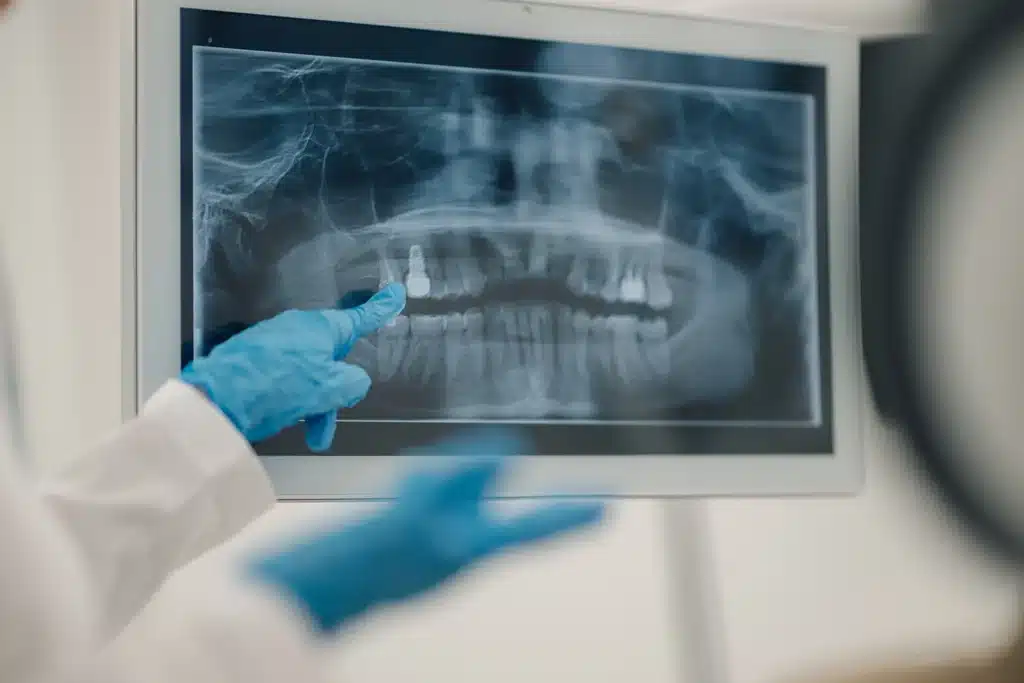
- Digital dental X-rays
- CBCT (cone beam computed tomography) scan, which is a three-dimensional scan
This gives your dental team a comprehensive picture of your jaw before any procedure begins. It allows them to:
- Evaluate available bone in three dimensions
- Measure bone heights and widths accurately
- Visualise sinus anatomy
- Plan the procedure with the final restoration in mind
This approach, planning backwards from what the replacement tooth needs to look and function like, is what makes the outcome more predictable, not just the short implant itself.
Wondering what this kind of assessment would show for your jaw? Book a consultation at Newlife Dental Practice and the team will walk you through exactly what the imaging reveals and what it means for your options.
Are Short Dental Implants as Safe as Conventional Ones?
Here are the necessary factors that must be met to ensure the success of short dental implants.
| Factor | Why It Matters |
| Case Selection | Short implants are not appropriate for every anatomy. Suitability must be confirmed before treatment begins. |
| Surgical Technique | Careful placement is what allows the short dental implant to bond reliably with the surrounding bone. |
| Prosthetic Planning | The replacement tooth needs to distribute bite forces evenly; otherwise the implant bears a load it was not designed to handle. |
| Long-Term Maintenance | Bone and gum changes around implants do not always cause obvious symptoms early on. Regular check-ups are required to catch them before they become a problem. |
| Patient Compliance | Brushing, flossing, and showing up to follow-up appointments are not optional. They are part of how the implant stays healthy. |
