
Summary:
- Bone grafting is not a required step for every dental implant patient in Singapore.
- Whether you need it depends on your individual bone volume, anatomy, and clinical history.
- Modern implant techniques, including ultra-short implants, have expanded options for patients with reduced bone.
- You’ll need a thorough assessment, including three-dimensional CBCT imaging, to know what your treatment involves.
In a survey of patients considering dental implants, 42% believed that bone grafting was an essential prerequisite for the procedure. In reality, it’s not. Sufficient bone typically exists for dental implant placement without any augmentation at all.
If you’re wondering whether you need a bone graft before implants, here’s what actually determines whether bone grafting is part of your treatment, and when it’s genuinely necessary.
Why Your Jawbone Matters for Dental Implants
Dental implants work by anchoring directly into the jawbone. Over time, the implant fuses with the surrounding bone in a process called osseointegration (the biological bonding of the implant to bone tissue). For this to succeed, there needs to be enough bone volume and density at the implant site.
The challenge is that bone naturally begins to shrink after a tooth is lost. This is called bone resorption, and it happens because the jawbone no longer receives the stimulation it once got from the tooth root. The longer a tooth has been missing, the more resorption is likely to have occurred.What Causes Bone Loss in the Jaw?
Several factors can reduce the bone available for implant placement. Common causes include:
- Long-term missing teeth, which allow resorption to progress over time
- Gum disease (periodontitis), which can damage the bone supporting the teeth
- Infection or trauma to the jaw
- Long-term denture use, which does not stimulate the underlying bone
- Natural sinus expansion, where the maxillary sinus (the air-filled cavity above the upper back teeth) expands downward after tooth loss, reducing available bone height in that area
Not all of these causes result in the same degree of bone loss, which is part of why two patients with similar histories can end up with very different treatment plans.
What Is Bone Grafting?
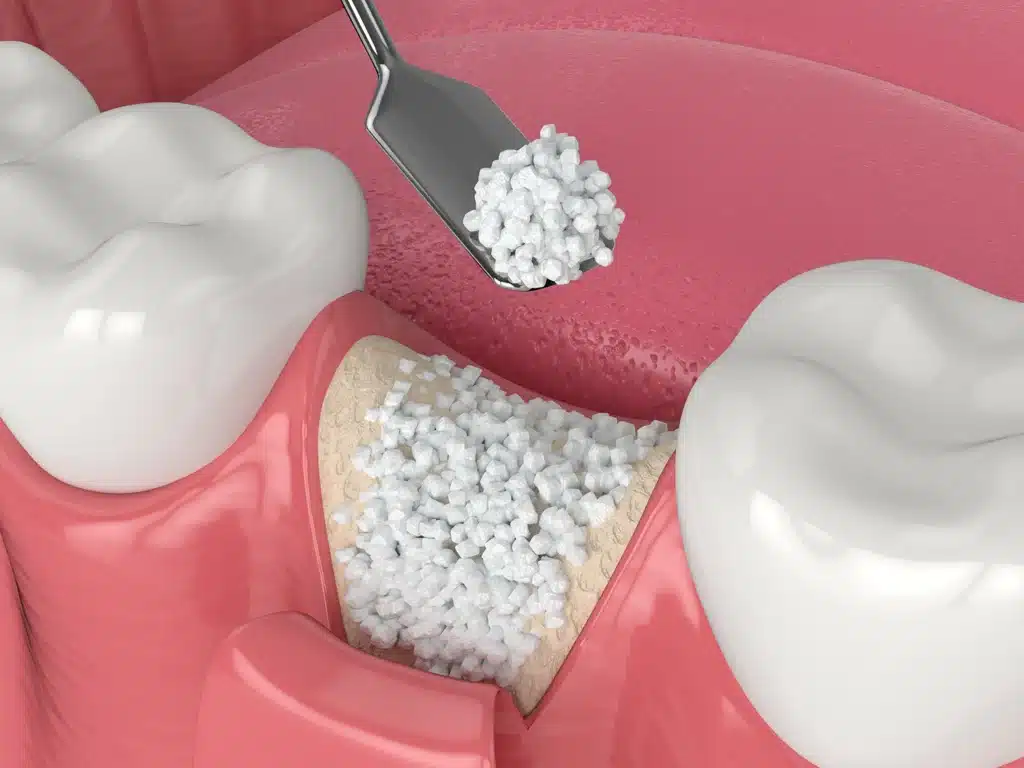
Bone grafting covers a range of procedures designed to increase or preserve bone volume at an implant site. Depending on your situation, this might include:
- Socket preservation, carried out at the time of extraction to protect existing bone
- Guided bone regeneration (GBR), where a membrane is used to encourage new bone growth
- Minor localised grafting, added at the time of implant placement
- Ridge augmentation, to rebuild bone height or width along the jaw
- Sinus augmentation (also called a sinus lift), used when there is insufficient bone height in the upper back jaw
The extent of grafting varies considerably. Some patients need only a small procedure carried out alongside implant placement. Others may need a staged approach, where grafting is completed and allowed to heal before the dental implant is placed.
When Is Bone Grafting Necessary?
The question of whether you need a bone graft before implants comes down to a few clinical factors. It may be the most appropriate option when:
- Bone volume is severely reduced and cannot reliably support an implant
- Stable implant placement cannot be achieved without additional bone
- The planned restoration requires a specific bone volume to function correctly
- Your anatomy or long-term biomechanical needs make augmentation the safer choice
Can Modern Implant Techniques Reduce the Need for Grafting?
In selected cases, yes. Newlife Dental Practice offers ultra-short dental implants, which are specifically designed for patients with limited vertical bone height. Where a traditional implant would previously have required a sinus lift or ridge augmentation first, ultra-short implants may be placed without those additional procedures, making treatment faster, minimally invasive, and more affordable for suitable patients.
Crestal sinus techniques also allow surgeons to approach the sinus floor with less disruption than a traditional open sinus lift. At Newlife Dental Practice, this is formalised as the Sinus Stability Protocol, a clinical framework developed by Clinic Director Dr Aaron Hoo.
The protocol first determines whether stability can be obtained from the available native bone. When it can, a shorter implant or a limited crestal sinus approach may sometimes reduce the need for a separate lateral augmentation procedure.
The underlying principle, that a stable implant in native bone creates the right conditions for healing to follow, is what makes a less invasive approach viable in appropriate cases.
CBCT (cone beam computed tomography) imaging means available bone can be assessed thoroughly, reducing uncertainty before any procedure begins.
Studies have demonstrated comparable survival rates between short implants and conventional implants with sinus augmentation in carefully selected cases. This does not mean bone grafting has become unnecessary. It means that for some patients who might previously have faced extensive augmentation, minimally invasive alternatives may now be worth exploring.
If you’ve been told that bone grafting is unavoidable, it may be worth finding out whether that still holds once your anatomy has been assessed with modern imaging. Find out what your options are at Newlife Dental Practice.
Why Minimally Invasive Surgery Planning Matters
More extensive surgery typically means:
- Greater post-operative swelling
- Longer recovery
- More discomfort in the days following treatment
- Higher complexity and cost
- More anxiety for patients in the lead-up to the procedure
Where it’s clinically appropriate to reduce surgical complexity, doing so can meaningfully improve your recovery experience and your overall willingness to proceed with treatment. This is not about avoiding what’s necessary. It’s about not adding to treatment unnecessarily.
What Does a Proper Implant Assessment Involve?
Every implant case is different, which is why assessment matters as much as it does. At Newlife Dental Practice in Singapore, the dental implant treatment process begins with a thorough consultation and assessment that includes:
- CBCT imaging to evaluate bone volume and anatomy in three dimensions, including bone height, width, density, and the position of key structures such as the maxillary sinus
- Anatomical and functional assessment of the implant site
- Risk analysis, including a full medical history review
- Prosthetic planning, so the final restoration informs surgical decisions from the outset
Treatment recommendations are reached by weighing implant stability, patient safety, biological factors, long-term function, and your individual circumstances. This level of assessment is what separates a treatment plan built around your actual anatomy from a general plan.
Book your implant consultation at Newlife Dental Practice and get a clear picture of what your treatment involves.
What About Sinus Lift Surgery and Extensive Grafting?
Sinus lift surgery remains an effective treatment for patients with insufficient bone height in the upper back jaw. However, modern implant dentistry increasingly considers alternatives where appropriate.
At Newlife Dental Practice, every upper jaw case is assessed using CBCT imaging, which measures available bone height and maps sinus anatomy to determine whether implant stability can be achieved within existing bone.
This approach, assessing conditions before deciding on intervention, reflects the Predictive Dentistry philosophy that guides how treatment is planned at the practice.
In some cases, ultra-short implants placed within available native bone can achieve stable integration without sinus augmentation. In others, sinus augmentation remains the most predictable path. The objective is not to avoid surgery at all costs. It’s to choose the most appropriate treatment for your specific anatomy.
A recommendation for bone grafting is not necessarily wrong. In many cases, it will be the right course of action. But if you’ve been told that you require significant augmentation before treatment can begin, it’s reasonable to want to understand why, and whether all available options have been properly considered for your specific case.
